The Queens Own Royal West Kent Regiment
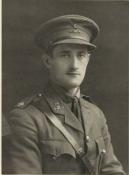
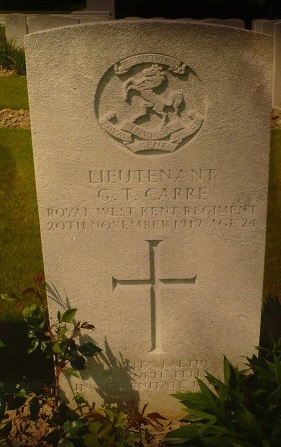
Lieutenant G T Carre
Lieutenant Gilbert Trenchard CARRE, 9th Battalion attached 6th Battalion, Queens Own Royal West Kent Regiment, killed in action, 20th November 1917, aged 24.
12thn December 1891, born at Weymouth, son of the Rev. and Mrs. A. A. Carre.
Educated at Lambrook School, BRacknell and at King’s School Canterbury from 1903 to 1909 where he was a member of the Cricket XI and the Rugby XV. On leaving school he worked as a schoolmaster at Eagle House School, Sandhurst.
18th August 1914, enlisted at St Pauls Churchyard, 5ft 8 inches tall, grey eyes, yellow hair, as a Rifleman in the 7th Battalion Rifle Brigade, where he rose to the rank of Acting Corporal in the Signal Section.
22nd February 1915, discharged from the Rifle Brigade in order to accept a commission; 23rd February 1915, commissioned 2nd Lieutenant, 9th (Reserve) Battalion, Royal West Kent Regiment; 23rd February 1915, posted 6th Battalion, Royal West Kent Regiment; 13th February 1916, posted BEF; 3rd July 1916, Ovillers, Somme, wounded.
On the 20th of November 1917 the battalion were involved in
the Battle of Cambrai. At 6.20am the lead companies advanced behind a screen of
tanks which crushed wire and was effective in dealing with enemy strong points.
As a result the following infantry took many prisoners and had little to do
until the strong point known as Pam Pam Farm was reached. Here the Germans put
up a stout defence, but with the tanks they were overcome, the battalion pushing
on to Lateau Wood and Le Quennett Farm. The Farm fell to the tanks as well and
some of the battalion entered Lateau Wood and began clearing it. Major Alderman
DSO began organising an attack on some machine guns to the north of the wood
which he was anxious to silence. He went forward with Lieutenants Bourchier,
Newsholme, Stiebel and Carre and a small party of men and working along the edge
of the woods, came upon a large party of Germans around the guns. Instead of
standing their ground, the Germans bolted and the small group of West Kents
secured the guns and set off in pursuit only to come under fire from inside the
wood. Major Alderman fell mortally wounded as did Lieutenant Carre. Lieutenant
Bourchier was killed outright and Stiebel was badly wounded.
His commanding officer wrote
Gilbert Carré was one of the principle characters for whom
Alan Thomas wrote his autobiography A Life Apart. Thomas wrote of Gilbert
Carré's death and the subsequent burial of five Royal West Kent officers:-
"The next morning I saw Gilbert lying on the ground. He had been carried from
the place where he had fallen near Lateau Wood to the ruins of Pam-Pam Farm. In
his eagerness he had rushed ahead of his men, careless of his safety. He had
been killed instantly by a bullet through the heart. There was hardly any trace
of the wound on his uniform, beyond a small hole. His eyes were closed and his
features were calm and unaltered.
His pockets had already been emptied by the stretcher-bearers, but they had left
his whistle which still hung by a strap from one of the buttons of his tunic. It
was one of the whistles I had handed out to him at Noeux and for which he had
given me a receipt "Received four sirens"(I have that receipt still). I
unfastened the whistle and did the tunic button up again.
For a little while I stood looking down at him, trying to understand what had
happened. Then I came away.
But the worst eruption of this General's temper occurred during Gilbert's
funeral. Five of our officers were buried that day, Alderman, Gilbert and three
others. They were buried in a common grave. The funeral service was held at
seven thirty in the morning. A little knot of us, including the General, stood
by the side of the grave while the Padre read the service. He was a nervous
little man, the Padre, and his voice reminded one of a stage curate's. That in
itself was enough to irritate the General (and the rest of us, too, for the
matter of that). Also it happened to be raining and we all of us wanted our
breakfast mitigations but not excuses for the General's outburst.
"Ashes to ashes, dust to dust", quoth the Padre, taking up a handful of earth
and scattering it upon the first body.
"Ashes to ashes, dust to dust", he repeated, taking up another handful of earth
and scattering it upon the second body.
The General shifted from one foot to the other and heaved a very audible sigh.
"Ashes to ashes, dust to dust", began the Padre, stooping for yet another
handful of earth.
The General exploded. "That's the third time you've said that!" he exclaimed.
"Why must you keep repeating yourself".
Even the tough ones among us were shocked at this interruption of the funeral
service. We took deep breaths and looked down our noses.
The Padre made a feeble attempt to stand his ground.
"The Church ordains, sir," he said, "that those words shall be spoken over each
body".
The General shrugged his shoulders. "Get on with it", was all he said.
To his shame the Padre funked the rest. Forsaking the ordinances of the Church
he scattered his last handful of earth upon the three remaining bodies, hurrying
through the words as best he might. In another two minutes the service was over.
I walked back with the General in silence.
At breakfast he turned to me suddenly and said: "You think I was right, don't
you, Thomas, to stop that fellow repeating himself like that?"
Fortunately, before I could answer, he retracted the question. "Oh, well. I
daresay I was a bit impatient", he grumbled. "Let's forget it."
8th July 1918, Probate - Carre Gilbert Frenchard, of The Rectory, Smarden, Kent. Lieutenant Royal West Kent Regiment, died 20th November 1917, in action in France. Administration Canterbury 8th July to Meyrick Heath Carre, Captain in Royal West Kent Regiment. Effects £128 19s 2d.
His brothers:
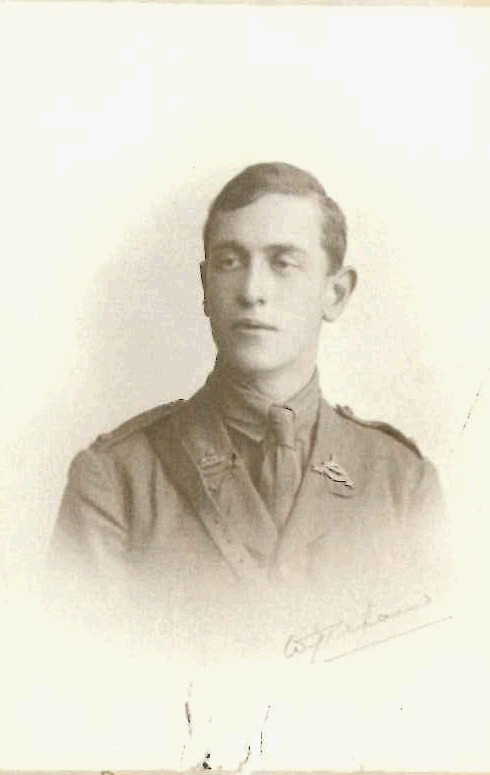
Lieutenant (Observer) Edward Mervyn Carré, of 15 Squadron Royal Flying Corps, was killed in action on the 16th of October 1916
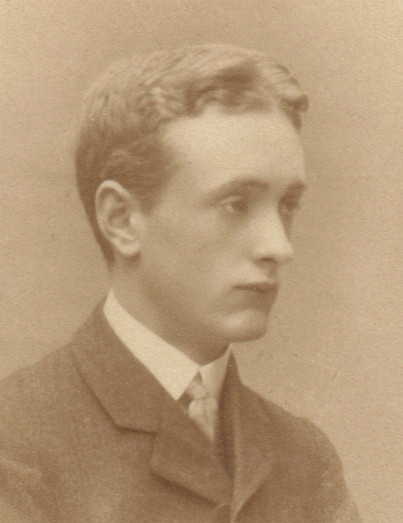
Private 1113 Maurice Tennant Carré, 1st Battalion Australian Infantry, was killed in action on the 2nd of September 1915.
Buried at Fifteen Ravine British Cemetery, III. B. 12., Villers-Plouich, Nord, France. Commemorated on the memorial at Eagle House School, Sandhurst & on the war memorial at Smarden & Lytchett Matravers, Dorset
London Gazette 7th June 1916.
War Office, 7th June, 1916. REGULAR FORCES.
The under mentioned temporary 2nd Lieutenants are transferred from Reserve Battalions (except where otherwise stated), with seniority from dates shown against their names:
Royal West Kent Regiment - G. T. Carre. 23rd February 1915.
London Gazette 23rd October 1917
War Office, 23rd October, 1917. REGULAR FORCES.
The under mentioned temporary 2nd Lieutenants to be temporary Lieutenants - 1 July 1917
Royal West Kent Regiment - G. T. Carre.
London Gazette 26th October 1917.
Royal West Kent Regiment. - The under mentioned temporary Lieutenants to be acting Captains (additional) :
20 July 1917. - G. T. Carre.
This page was last updated on 17-Aug-2017.
Copyright © 2008 Janet & Richard Mason