The Queens Own Royal West Kent Regiment
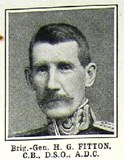
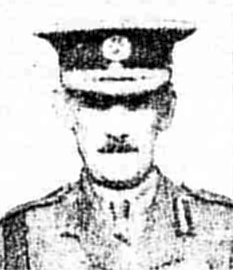
Brigadier General H G Fitton
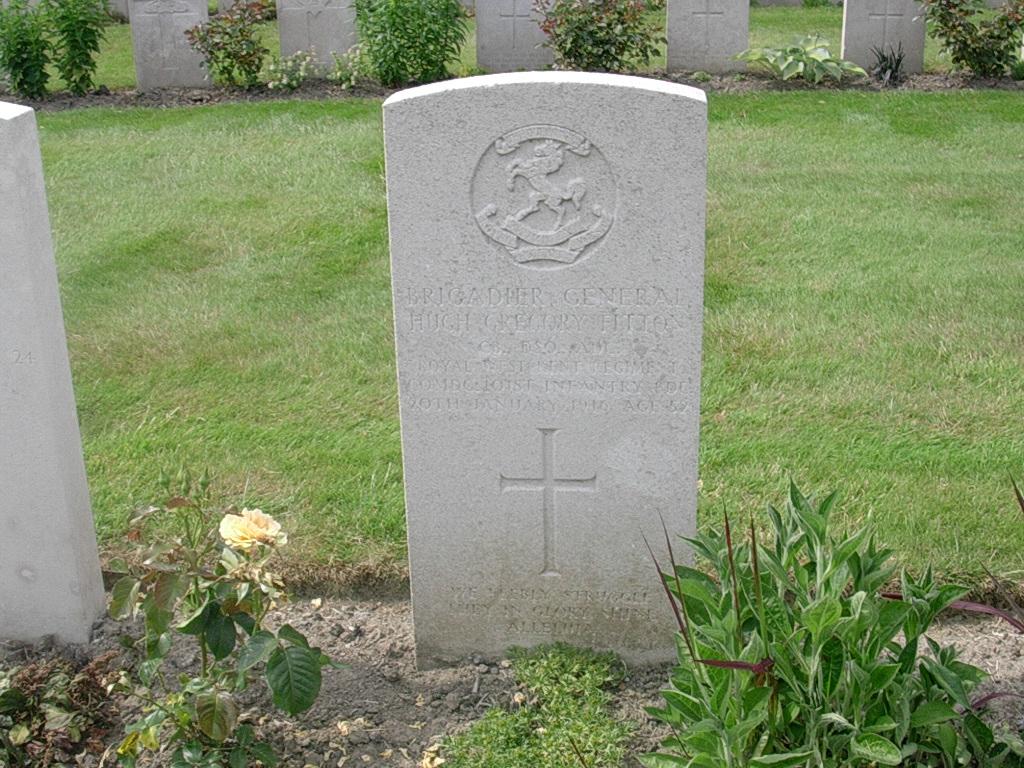
Brigadier General Hugh Gregory FITTON, CB. DSO.General Staff, Commanding 101st Infantry Brigade, (secondary Regiment, Queens Own Royal West Kent Regiment), died of wounds, 20th January 1916, age 52.
Born 15th November 1863, Gloucester Crescent, Hyde Park, London, London. Second son of Edward Brown Fitton, (Barrister & Inspector of Factories), of Malvern, Worcestershire and Harriet Margaret Gregory.
He had one brother, Guy William and five sisters - Clara, Ethel Margaret, Isabella Jane, Hilda Mary and Monica.
The family was musical and connected through his maternal
side of the family to the Edgar family. Sir Edward William Elgar, 1st Baronet,
was indeed a renowned musician and composer and Hugh's mother and sisters had
many pieces of music dedicated to them.
Hugh’s sister Isobel was the inspiration for one of Elgar’s Enigma Variations:
Variation VI ‘Ysobel’. Lady Elgar mentioned Hugh in her diary of 1912.
Kings Scholar at Eton and passed first on the list into Sandhurst in 1877 where he was first on the list in 1883.
A distinguished army career followed.
He served in several of the Sudan 1885, Egypt 1885-86 and
several Nile Expeditions in the 1890s and then in the Boer War 1899-1902.
For his service and conduct during this period, he was awarded the Egyptian Medal with two clasps, was Mentioned in Despatches, and was created a Companion of the Distinguished service Order. He also received a further promotion and was granted the rank of Captain in 1893.
He took part in the Nile Expedition in 1897, during which he served as Staff Officer for a Flying Column that participated in the occupation of Barber and the march to the Atarba River. For his conduct during this period, he was Mentioned in despatched for a second time.
He participated in another Nile Expedition in 1898, serving as Deputy Assistant Adjutant General and taking part in the battles of Atbara and Kertoum. On the eve of the former, despite the lack of landmarks and the darkness of the night, he managed to guide four companies to within 200 metres of their intended position. He thus demonstrated on this occasion his orienteering skills equal to those of those desert peoples and was mentioned in Lord Kitchener's Despatch for this feat.
A few months later he was also brevetted Major on 16th November 1898.
The following year, in 1899, the Boer War (1899 - 1902) broke out, in which he participated like many other British soldiers. He served first as Deputy Assistant Adjutant General and later as Deputy Assistant Quartermaster General, in the 7th Division throughout the war. He participated in the Orange Free State between February and May 1900, including Paardeberg, but also in actions in Poplar Grove, Karee Siding, Vet River and Zand River. Later in June he participated in operations in the Transvaal, including actions near Johannesburg and Pretoria at the end of June. He returned to the Transvaal in November 1900 and remained tkere until May 1902, and was Mentioned in Despatches for the third time in September 1901. Shortly after the end of the conflict, he transferred to The Royal Warwickshire Regiment before transferring a second time in February 1904 to The Royal West Kent Regiment, where he served as second in Command.
In early 1905, he moved to a new part of the world and commanded the West Kent Regiment in Hong Kong and Singapore. It was during this stay that he was promoted again, this time to the rank of Lieutenant- Colonel.
He left office in early 1907 when he was appointed Aide-de-Camp to King Edward VII. He then received a further promotion and was brevetted Colonel on 12 February on 12th February 1907.
Upon the death of King Edward VII on 6th May 1910, his successor, George V, wished to surround himself with a team he trusted but also to retain existing staff to ensure continuity of office. He was one of those men who retained their position.
I5th October 1910 he married May Hickman, (sixth daughter of of Sir Alfred Hickman, Baronet of Wightwick, Wolverhampton, a former MP for Wolverhampton). The couple lived in Prince Consort Road, London. He was a tall man. As a brigadier it was written of him: “Nothing was too much trouble to him as long as his men were thoroughly trained and he had their love and respect” He had a “habit, which endeared him to all, of doing himself everything that the men were asked to do.”
He was a member of the Worcesterhire Golf Club, a third of the club to be lost during the War. His brother Colonel Guy William Fitton, and Old Malvernian, served in the Army Pay Department.
In 1911 he was made a Companion of the Order of Bath.
1911 Census - 42 Albert Court, Kensington Gore, Prince Consort Road, London SW - Hugh Gregory FITTON, born St Margaret & St John, Paddington, age 47, married, Colonel His Majesty Service, Army; May Fitton, wife, age 45, born Ledgten?, Staffordshire, married under one year; Katherine Josephine Kettle, sister in law, age 48, widow, private means, born Great Barr, Staffordshire: Maud Bolt, servant, maid, age 32, spinster, born Exeter, Devonshire; Sarah Ann Howman, servant, age 46, spinster, born Albrighton, Shropshire; Emily Winter, servant, house maid, age 26, spinster, born Shelley, Surrey; Gladys Wesley, servant, housemaid, age 18, spinster, born Wolverhampton, Shropshire; Ellen Allen, servant, cook, age 29, spinster, born Islington, London.
The couple settled in Tynemouth, where they quickly became involved with the Priory Institute, the YMCA and numerous local relief funds.
From 1913, he took up the post of Director of Recruiting and Organisation, War Office, a position he still held when World War One broke out in the summer of 1914.
In November 1914 he was promoted to Brigadier General and assumed commend of Costal Defences on the East Coast of England.
In 1915 he was appointed Commanding Officer of the 101st Infantry Brigade and prepared to be deployed to Egypt with his men. Nevertheless he was sent to the European Continent to serve with the Expeditionary Force in France and Flanders.
In January 1916 he visited the 16th Infantry Brigade which was stationed near Vlamerthinge Ypres to learn about trench warfare. He was participating in a training tour of the front line trenches during the night of 18-19 January 1916, along with other officers, when they arrived at a communication trench that had been destroyed by a previous bombardment. The men would therefore be forced to move briefly in the open in order to continue their advance, but they would not be exposed to danger for long. The men ran, making as little noise as possible, but enemy snipers were on the lookout for this natural trap. The men were spotted when the moonlight offered opportunities to fire, the snipers didn't hesitate and concentrated their fire on the lead man in the group, he was the first to rush forward. He had little chance of reaching his destination unharmed and he was shot through both thighs by a sniper. The other officers retraced their steps to inform the troops of the incident and find help. They returned to the scene with stretcher bearers who managed to reach him and bring him to safety and evacuate him to No.10. Casualty Clearing Station. The medics did their best but he had been hit by several bullets, had puncture wounds to both thighs that had reached his arteries. Despite the speed and quality of care he received, his condition deteriorated rapidly and steadily, he finally died on January 20th 1916, at around 1.20pm.
From June 1917 his widow May lived in the village of Steep, near Petersfield, Hampshire. She leased Island House and land about it, which she later bought in 1932. The gardens of Island House were designed by Inigo Triggs, who also created the War Memorial at Mill Lane, Steep. May lived at Island House until her death in 1954 at the age of 88 years and is buried at Steep church.
Buried at Lijssenthoek Military Cemetery, II. A. 27., Belgium.
AWARDS: C B, D S O
Additional Information: A.D.C. Order of the Medjidie 4th Class (Turkey), Khedive's Bronze Star. Served in the Egyptian Army 1894-99.
This page was last updated on 12-Sep-2025.
Copyright © 2008 Janet & Richard Mason